

I ran the same question three ways.
First I asked Gemini, “Where can I volunteer near me?” It returned five organizations, each with a star rating, open or closed status, and three bullets. Alemany Farm was there, with planting, weeding, and harvesting workdays. So were Family House and CityTeam. Greening Projects, the nonprofit I work for, wasn’t.
Then I asked Perplexity the same question. It answered for the whole city: the SF-Marin Food Bank, GLIDE, and a set of city park and cleanup programs. We weren’t in that answer either.
Then I gave Perplexity my zip code, 94110. This time it recommended Greening Projects and Tompkins Stairway Garden, our own project, and suggested starting with one of them. Two of its four options were ours.
What changed
Nothing about our organization changed between those answers. The question did. “Near me” is vague, and an AI, when faced with such a question, tends to reach for big, well-known names. Once it had a neighborhood, it looked for organizations that clearly operated there.
The trouble is that almost nobody types a zip code on the first try. They type the vague version and act on whatever comes back. Both tools asked a follow-up question (Gemini asked what kind of volunteering I wanted, and Perplexity asked for my neighborhood), but plenty of people will skip that and pick from the first list.
Two tools, two different sources
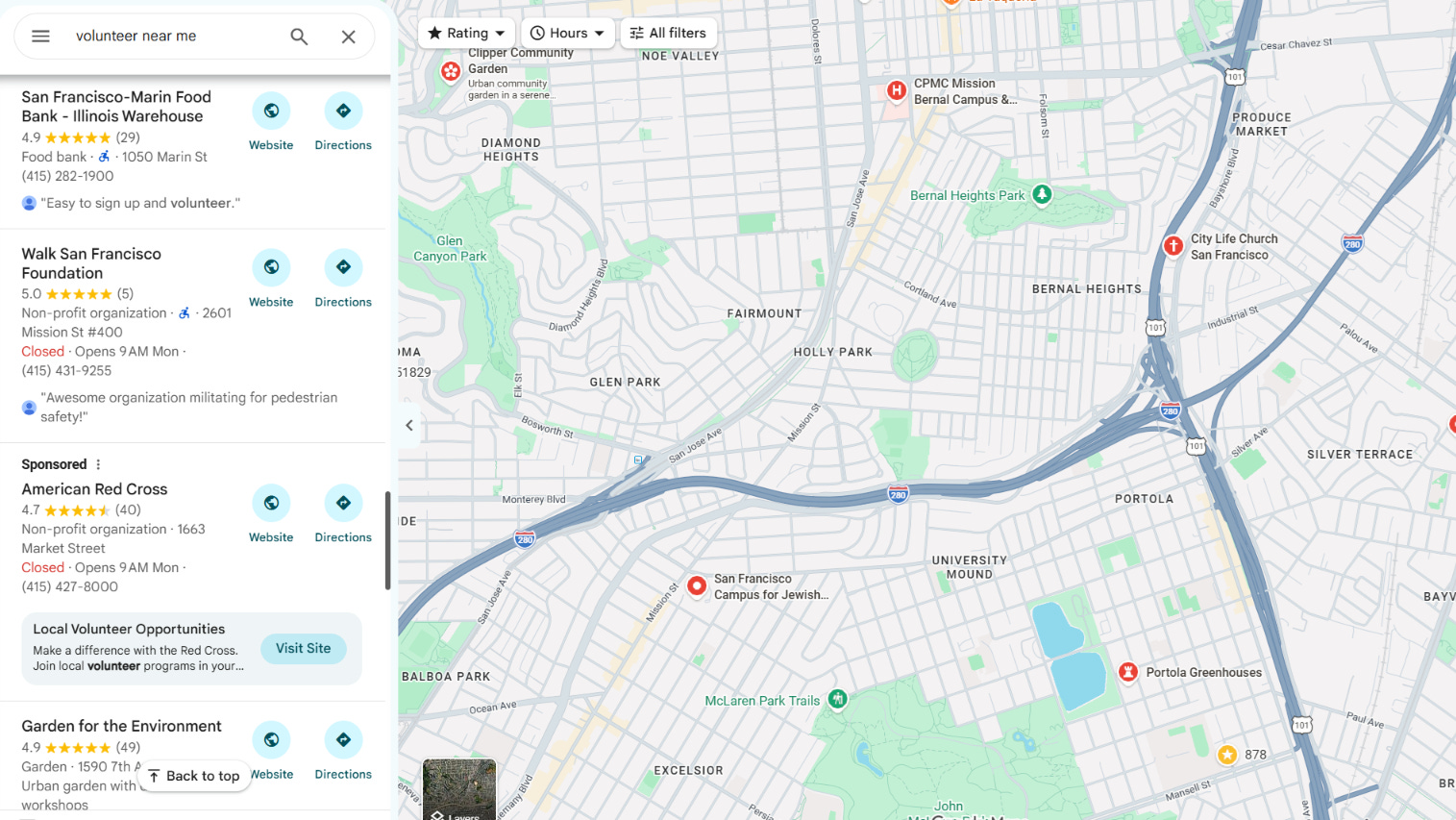
The two answers looked like they were made of different materials, so I tested them. I searched Google Maps for the same phrase, “volunteer near me,” and compared.
Four of the five organizations Gemini recommended appeared in the Maps results with identical ratings, hours, and descriptions. Gemini didn’t simply copy the top of the list, though. It skipped the SF-Marin Food Bank, which had more reviews than anyone, and seemed to favor organizations with clear volunteer activities, like Alemany Farm’s planting and harvesting workdays. Perplexity pointed people to the city’s volunteer directory and to organizations’ own project and signup pages. I can’t see inside either tool, so the Perplexity side is an inference from what it returned.
Then I looked for us. Among the roughly thirty Maps results, Greening Projects wasn’t there.
That means getting found is two jobs. A strong website won’t help you in Gemini if your Maps listing is missing or thin, and a strong Maps listing won’t help in Perplexity if the open web has little to say about you.
Why I think we were missing
I read our Google Business Profile with fresh eyes. It describes our mission well: communities turning empty lots and bare sidewalks into green spaces, with benefits for food security, flood control, and air quality. It ends with an invitation to help us plant the seeds of resilience.
The word “volunteer” never appears. Neither does a task, a neighborhood, or a time.
That’s the same problem as a volunteer page that opens with “Join our passionate community of changemakers!” The language is inspiring, but it gives a system matching a search for “volunteer” very little to work with. The listings that did appear had reviewers writing things like “Easy to sign up and volunteer.”
This is my best guess, not a confirmed diagnosis. I can’t see how Google weighs any one field, our business category, the number of reviews that mention volunteering, or where our website link points, as factors. But the profile is the first thing I’m fixing.
The part that stung
Perplexity also flagged a problem. For the Tompkins Stairway Garden workday, it told the reader to check the project page before going, because published pages disagree on whether it starts at 9 or 10 a.m.
That was our mistake. The workday starts at 10 on the first Saturday of each month, and somewhere on our own pages it said 9. A volunteer who trusted the wrong page would have shown up an hour early to an empty stairway.
When an AI finds two answers on your pages, it passes the confusion along to the person deciding whether to show up. Perplexity also noted that its results were sign-up options, not confirmation that a shift had space. These tools are cautious about details they can’t verify, so contradictions cost you.
We’ve since made the project page the single source of truth for workday times and corrected everything else to match.
Getting into the vague answer
The harder question is how to appear when nobody narrows things down. Based on what each tool seemed to draw from, there are two jobs.
For Gemini and other Maps-driven answers, start with your Google Business Profile. Say what volunteers actually do, where, and when, and use the word “volunteer.” Check that your category fits: Alemany Farm is listed as a farm and another organization as a volunteer organization, so a vague category may make you easy to miss. Point your website link at your volunteer page instead of your homepage. And ask happy volunteers to share their experiences in reviews, since reviews appeared to shape the summaries. Don’t script what they say or offer anything in return, which Google prohibits.
For Perplexity and other web-driven answers, work on your pages and your presence. Get into the city’s volunteer directory, which Perplexity pointed to again and again. List yourself on platforms like VolunteerMatch and Idealist. Local press, partner organizations, and roundups of ways to volunteer in your city all give the AI more places to find you.
Make your own pages easy to quote
Listings may get you into the broad answer, but your own pages decide what happens once someone narrows the question.
Name your neighborhoods and zip codes where it makes sense, on your volunteer and project pages. Our result depended on that. List the actual tasks, when and where they happen, and whether people need experience. Give one clear next step, like an interest form or a signup calendar, along with what to include. Check that hours, start times, and addresses match across your site, your Google profile, and your directory listings, because where they conflict, the AI will say so out loud. And use numbers when you have them. “Reduced local food insecurity by 15% in 2025” is something an AI can cite, and “highly effective” isn’t. Use your real figures.
What I still don’t know
We showed up once the question was specific. We haven’t yet shown up in the answer to “where can I volunteer near me,” the one most people will actually type.
This week I’m rewriting our Google profile to clearly state what volunteers do, checking our category and website link, and working through the city directory and volunteer platforms. In part two, I’ll share what we changed, what we skipped, and whether either tool’s answer moved.
If you want to follow along, subscribe and part two will land in your inbox.
Try it yourself
Run three versions of the question for your organization: the vague one (“where can I volunteer near me”), one with your neighborhood or zip code, and one with your cause (“community garden volunteer in [your city]”). Use at least one tool that relies on Google Maps, such as Gemini, and one that searches the open web, such as Perplexity. Then search Google Maps for the same phrase and see whether you’re there.
Note where you appear, where you don’t, and what the AI says about the organizations it picks instead. Then read your own Google profile and ask whether a stranger would know what a volunteer does there.