

By M. Patrick Doherty, Greening Projects Newsletter
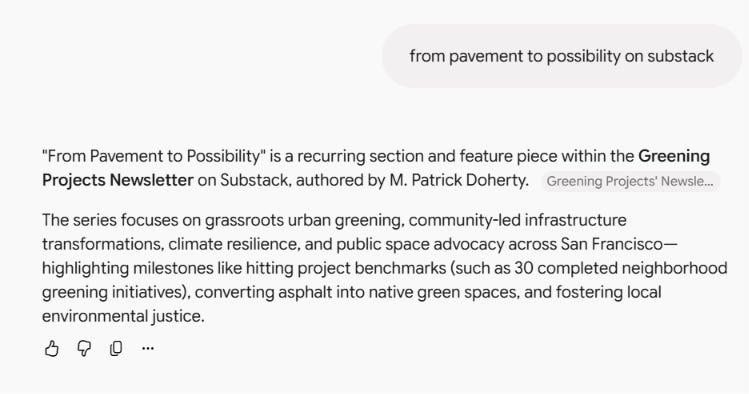
I typed six words into Google Gemini: my series name and “on Substack.” The answer was accurate. The two follow-up questions that came after it taught me far more.
The series, From Pavement to Possibility, is a recurring feature in the Greening Projects Newsletter. It covers grassroots urban greening in San Francisco: community-led infrastructure transformations, asphalt turned into native green space, climate resilience, public space advocacy, and local environmental justice. I know what I mean it to be. I wanted to know what it reads like to a stranger who has only the internet to go on.
Three prompts
from pavement to possibility on substackis it worth reading?what would a recommendation of the newsletter sound like?
The first is how a curious stranger would look you up. The second is what they actually want to know. The third is the one I’d never have thought to ask, and it turned out to be the most revealing.
Prompt one: does it know what you are?
Yes. Gemini described a San Francisco series on grassroots greening, community-led infrastructure, converting asphalt to native green space, climate resilience, and environmental justice, with milestones like 30 completed neighborhood projects. It got it right.
One detail is worth a second look. Gemini introduced the series as a recurring section inside the Greening Projects Newsletter, but its later recommendations tell readers to subscribe to From Pavement to Possibility on Substack, as if it were its own publication. If you run a section inside a larger newsletter, check whether the AI keeps the two straight.
Prompt two: Is it worth reading?
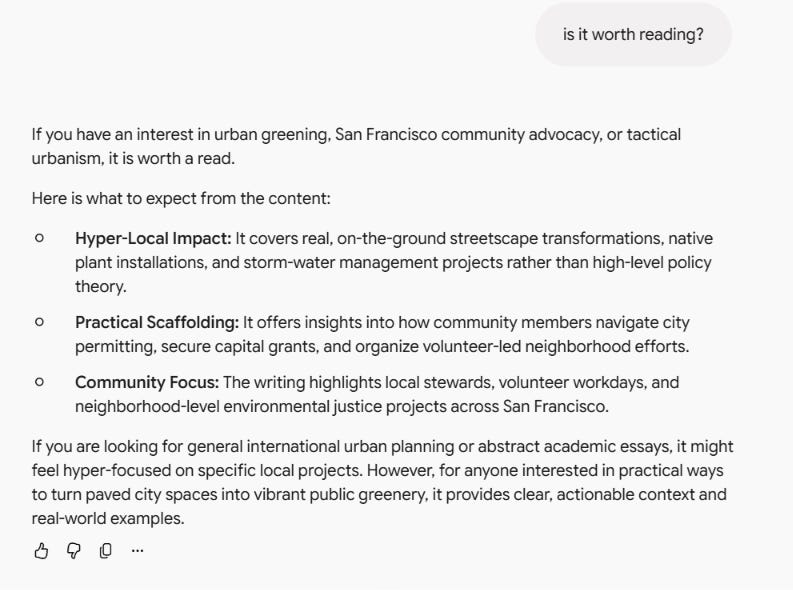
This was the most useful answer, because it came with conditions. Gemini said yes if you care about urban greening, San Francisco community advocacy, or tactical urbanism, and it described what to expect:
Hyper-local impact: real streetscape changes, native plantings and stormwater projects rather than high-level policy theory.
Practical scaffolding: how neighbors handle city permitting, win capital grants and organize volunteers.
Community focus: local stewards, volunteer workdays and neighborhood-level environmental justice.
Then it did something I would never put on my own About page. It said who the series isn't for: readers looking for general international urban planning or abstract academic essays. Telling people who should skip you is a mark of an honest recommendation, and it makes the readers who stay more certain they're in the right place.
Prompt three: three voices, three audiences
I asked for a recommendation, and Gemini wrote three, each pitched to a different person:
A peer-to-peer tip about how San Francisco gets greened block by block, stressing the permitting, grant work, and cleanup behind each project.
A neighborhood group pitch about volunteer workdays, green daylighting, and turning underused pavement into native gardens.
A planning and advocacy blurb about tactical urbanism, municipal processes,s and mobilizing grassroots greening.
Read them as audience segments: curious neighbors, volunteers and organizers, and professionals or advocates. Each leads with different words. The neighbor hears “block by block,” the organizer hears “volunteer workdays,” and the planner hears “tactical urbanism.” If you wondered which of those readers you’re writing for, the AI just handed you a first draft of the answer.
It is only a draft. Gemini inferred these groups from public text, not from your subscriber list, and it says as much at the bottom of its own answer: it can make mistakes.
What to do with it
Check the segments against your stats. Do your Substack numbers and replies show neighbors, organizers, and professionals in roughly those proportions, or is one group missing?
Borrow the stranger’s words. Phrases like “from asphalt to native plants” and “permitting, grant work and neighborhood cleanup” are how an outsider summarizes you. They may belong on your About page.
Write your own “not for you” line. One honest sentence about who this isn’t for can do more than another paragraph about who it is.
Try it yourself
Search your publication’s name the way a stranger would.
Ask the AI whether it’s worth reading, and note the conditions it attaches.
Ask for recommendations in two or three different voices, and treat each voice as a possible reader.
Then put the answers next to your real data and your real readers. The AI can tell you how you read. Only your audience can tell you whether it’s right.
I expected a summary. I got a rough map of who might be reading, in about five minutes and three questions.
FAQ: How to Get AI to Recommend a Substack Channel
Q: Why do AI engines recommend some Substack newsletters over others? A: AI models like ChatGPT, Claude, and Gemini rely on Generative Engine Optimization (GEO). They don't just look at keywords; they check entity authority, live web crawlability, and cross-web consensus to determine which newsletters are trusted in a specific niche.
Q: How important are mentions on other websites for AI recommendations? A: Third-party mentions are the single strongest driver of AI visibility. AI models cross-reference external sources, such as Reddit discussions, industry roundups, guest posts, and digital media coverage, to confirm a newsletter is legitimate and relevant before citing it.
Q: How should I structure my Substack content so AI scrapers can read it? A: Make your articles extraction-friendly by using clear headings, bulleted summaries, and concise definitions. AI models use Retrieval-Augmented Generation (RAG) to pull direct answers, so structuring your posts logically helps them get surfaced and cited.
Q: Do paywalled Substack posts help with AI visibility? A: No. Paywalled posts cannot be indexed by public AI crawlers and search engines. You must keep foundational, pillar articles public and accessible so language models can process and learn from your content.
Q: What is the best way to make sure the AI knows my newsletter’s niche? A: Build strong co-occurrence by consistently pairing your newsletter title and tagline with your specific topic across your Substack About page and external web mentions. This helps AI vector embeddings correctly link your brand to that topic authority.