

Jump to Resource Categories
Strategy & Governance | Fundraising & Development | Marketing & Brand | Programs & Impact
Operations & Finance | Technology & Infrastructure | Advocacy & Equity | Frequently Asked Questions
Recently I had coffee with a digital strategist, and we did what marketers do: traded war stories and griped about how hard it is to get organic reach and donor conversions. I told her my biggest obstacle was not having a massive, pre-existing email list or a viral social media presence. She didn’t even pause.
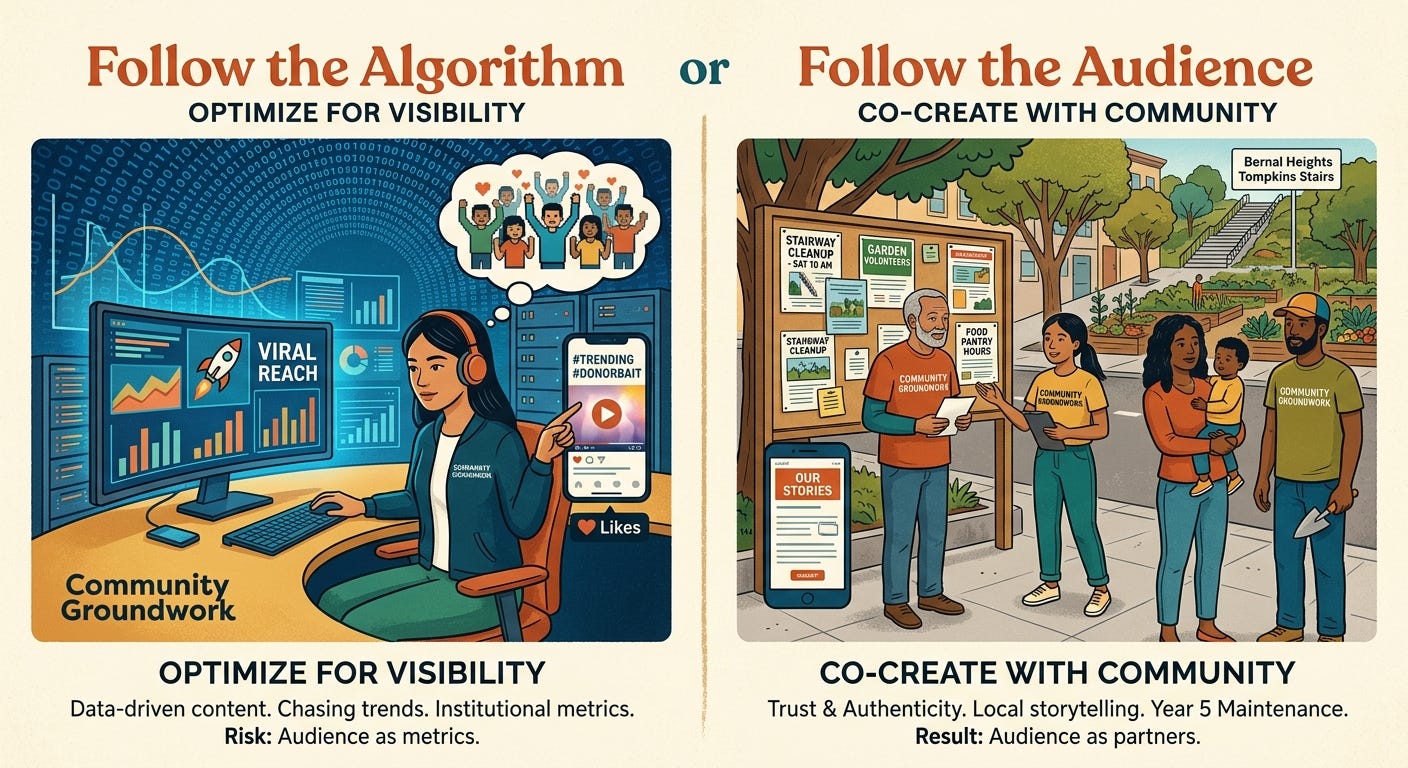
“You have it backward,” she said. “You find what the high-paying ad networks and major donors are clicking on first, and then you build your digital content strategy around what triggers the algorithm.”
I smiled and nodded. Inside, it didn’t sit well, and it still doesn’t. So, am I wrong?
A neglected neighborhood corner in the digital age
A local community initiative in my city shows what’s bothering me.
For years, grassroots groups in working-class neighborhoods have struggled to get digital visibility. Their websites are buried on page three of search results, their social feeds are quiet because volunteers are too busy running real-world programs, and digital grant-writing resources flow almost exclusively to organizations that already have professional marketing teams on staff.
When a neighborhood finally gentrifies or attracts tech-backed funding, the digital presence transforms overnight. Suddenly, the neighborhood has a polished website, sleek professional photography, targeted paid social ads, and optimized local search schema.
The underlying community need on that hillside was just as urgent twenty years ago as it was after the digital makeover. What changed was whether the organization had the software licenses, SEO know-how, and marketing budget to capture online attention.
What the strategist gets right
My colleague isn’t entirely wrong. Resources and visibility also get things built in the digital space.
She is also right that online metrics and donor analytics aren’t inherently dirty. Understanding what drives clicks—whether it is a compelling story, a clear call to action, or an emotional connection—is just good respect for your audience’s attention. Digital channels help organizations scale impact in ways word-of-mouth alone cannot touch.
Where the “algorithm-first” approach goes wrong
My problem is the order of operations. Find the trending keyword or donor-bait topic first, then build your content around it, and the algorithm’s taste becomes your editorial board.
Traditional digital marketing rewards what performs best on ad networks and social feeds: high-gloss, easily digestible, emotionally reactive content. That is understandable. But make it your default playbook, and well-resourced nonprofits keep collecting more digital share of voice, while grassroots organizations working with vulnerable populations become completely algorithmically invisible.
Waiting for viral success or a major donor-funded digital campaign can’t be the strategy for every community initiative that needs to reach people.
There’s a quieter cost, too. When an algorithm or a high-dollar donor defines your digital messaging, your community members become passive audience members or fundraising metrics instead of active partners. A neighborhood might need digital outreach for a food pantry, a multilingual health workshop, or a tenant rights meeting. Few of those generate high click-through rates or viral ad engagement, so a metrics-first approach screens them out before anyone ever hits publish.
What the organic approach costs
Starting with the actual community conversation is slower. It’s less likely to produce a sudden traffic spike or an instant wave of online donations, and some grant funders will walk if your metrics don’t match the vanity numbers in their pitch decks.
My colleague’s method probably generates quick digital vanity metrics faster. If a community-led digital strategy grows more slowly, I have to defend that.
I can, mostly. Digital reach is only useful if it connects people to services they actually use, and a beautifully optimized campaign nobody asked for is still a miss. Ground-level authenticity pays off differently online, too. A paid ad campaign can buy clicks and then vanish when the budget runs out. But an authentic community digital presence—built on real local stories, regular newsletters, and genuine engagement—keeps people showing up, subscribing, and volunteering year after year.
What I’d do instead
I’d still start with what local residents and grassroots leaders say they need online, not what automated keyword tools suggest and not what an institutional funder wants to see in an impact report. Then I’d look for digital channels that naturally fit those real stories.
I’d also spend more time on digital capacity-building before chasing vanity metrics. Grassroots groups don’t always need a massive ad budget; they often need help setting up a simple email newsletter, optimizing their basic local search presence, or learning how to tell their own stories without burning out. Organizations without that digital infrastructure aren’t less deserving of an audience, and a good marketer can provide exactly that: structural support, clear templates, and guidance for navigating the digital landscape.
And I’d plan for year five of a digital strategy, not just launch day. Consistent, unglamorous digital maintenance—replying to comments, updating resource directories, keeping newsletters going when momentum dips—is exactly why so many nonprofit content strategies quietly fail.
So, am I wrong?
I walked out of that coffee shop unsure. I still don’t think I’m wrong, though I understand the digital strategist’s point of view better than I did.
I keep wondering how many vital grassroots initiatives remain invisible online, waiting for an algorithm to notice them, and who will help them tell their stories before their neighborhood changes beyond recognition.
I’d rather be the digital marketer who goes looking for the quiet stories.